
Axe throwing is scored like darts with axes: you throw a hatchet from behind a line about 12 feet away, and you earn points based on which ring the blade sticks in. On the standard World Axe Throwing League (WATL) target, the bullseye is worth 6 points, the rings around it count down from 5 to 1, and a called killshot is worth 8. It’s a physical, in-person sport - not a video game - and the scoring takes about two minutes to learn.
The essentials, at a glance:
- Bullseye: 6 points (the small center dot)
- Rings: 5, 4, 3, 2, then 1 point moving outward
- Killshot: 8 points - but only if you call it before you throw
- Match length: 10 throws; the highest total wins
- Distance: 12 feet for a hatchet, 15 feet for a big axe
How does axe throwing scoring work?
Every throw scores the value of the zone the blade sticks in. Miss the wood, or fail to stick so the axe drops out, and you score zero for that throw. The axe also has to stay in the target when the coach or judge calls the score - one that falls before it’s counted doesn’t earn its points.
Most venues, including every Craft Axe Throwing location, score on the standard World Axe Throwing League (WATL) target: a set of concentric rings with a small red bullseye in the center and blue killshot dots near the corners.
| Target zone | Points |
|---|---|
| Bullseye (center dot) | 6 |
| First ring out (the 5-ring) | 5 |
| Next ring (4-ring) | 4 |
| Next ring (3-ring) | 3 |
| Next ring (2-ring) | 2 |
| Outer ring (1-ring) | 1 |
| Inner killshot (blue dot) | 8 |
| Outer killshot (blue dot) | 7 |
A regulation target is built from soft wood planks - each plank roughly 1.5 inches thick and about 4 feet tall - so the blade bites and holds. The bullseye itself is only 1.5 inches across, about the size of a golf ball, which is exactly why sticking one feels so good.
What is a killshot in axe throwing?
The killshot - some leagues call it the clutch - is the highest-value target on the board. On a WATL target it’s a small blue dot, 1.5 inches across, tucked near the corners inside the 1-point ring. Stick the inner killshot and you score 8 points; the outer killshot is worth 7.
The catch: you have to call it. Say “killshot” (or point to it) before you throw. If you call it and miss the dot, the throw scores zero - even if the axe lands dead-center in the bullseye. And if you stick the blue dot without calling it, you only get the 1 point of the ring it sits in. WATL gives you just two killshot calls per 10-throw match, so throwers save them for the moments they need the points.

How do you win an axe throwing match?
A standard match is 10 throws. Two competitors alternate - you throw, your opponent throws, back and forth - and whoever has the higher total after 10 throws wins. Stick all 10 in the bullseye and you’d score 60; killshots push the ceiling higher.
If the match is tied after 10 throws, it goes to sudden death: both players throw at the killshot only, one throw at a time, until someone out-scores the other. That’s the format WATL and most sanctioned leagues use, and it’s the one our coaches teach once a group is ready to keep score for real.
WATL vs. IATF: what’s the difference in scoring?
Two organizations sanction most competitive axe throwing, and their targets score a little differently:
| WATL | IATF | |
|---|---|---|
| Bullseye | 6 points | 5 points |
| Rings | 5, 4, 3, 2, 1 | 3, then 1 |
| Killshot / clutch | 8 points (inner) | 7 points |
| Throws per match | 10 | 10 |
| Distance | ~12 ft (hatchet) | ~12 ft |
The practical upshot: WATL targets have more rings and higher top-end values, so totals run higher. IATF (the International Axe Throwing Federation) keeps it simpler with a 5-3-1 target and a single 7-point clutch. If you’re throwing recreationally, you’ll almost always be on a WATL-style board - it’s the setup you’ll see at most North American venues, ours included.
What are the basic rules of axe throwing?
Scoring is only half of it. A handful of universal rules keep a match fair and safe:
- Throw from behind the fault line. The line sits 12 feet from the target for a standard hatchet and 15 feet for a big axe - far enough for one full blade rotation. Step over the line as you throw and the throw doesn’t count.
- One thrower at a time. Only the person throwing is at the line; everyone else stays back until the axe lands.
- Blade facing away. On an overhead throw, the blade points away from you, never toward your body.
- It has to stick to score. An axe that bounces out or drops before the score is called earns zero.
- Retrieve together, on the coach’s cue. Nobody walks to the target until the lane is clear.
Those last few overlap with the safety rules every venue teaches - we broke the whole safety system down in is axe throwing safe?.
Are there other ways to keep score?
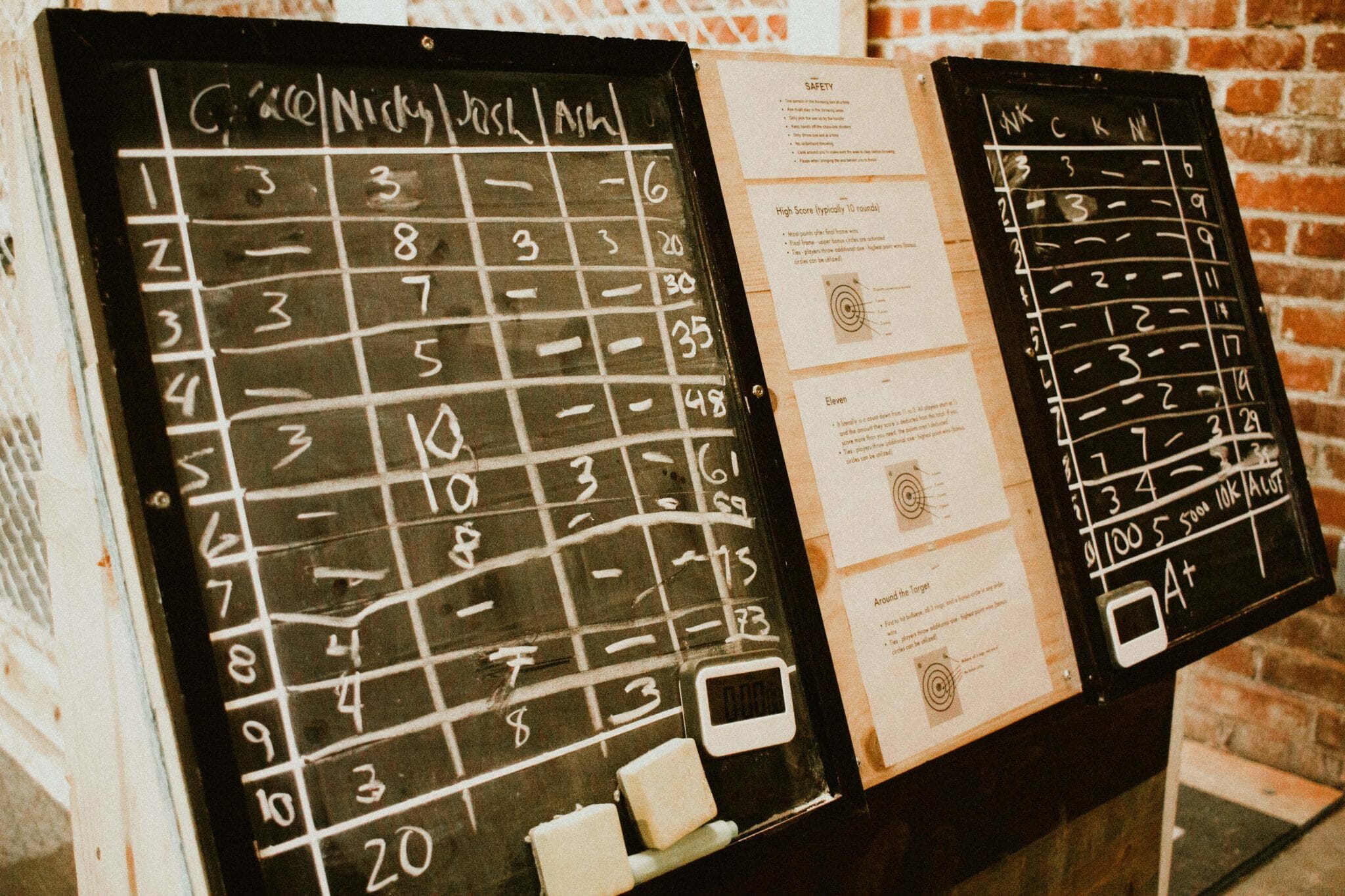
Yes. The 10-throw format is the competition standard, but plenty of groups play casual games built on the same target - counting only bullseyes, running an elimination bracket, or racing to a number like 21 and “busting” if a throw takes you over. We wrote up eight of those formats - Around the World, 21, Knockout, Cricket, and more - in our guide to axe throwing games beyond standard scoring. Our coaches keep a running tally on a chalkboard right at the lane and can set up whatever format fits your crew, from a laid-back first-timer round to a full head-to-head bracket. Half the fun is trash-talking between throws while the totals climb.
How does scoring work at Craft Axe Throwing?
You don’t need to memorize any of this before you visit. Every session at Craft Axe Throwing starts with a coach who teaches grip, stance, and release, then walks your group through scoring before the first competitive round - most first-timers are keeping score by the end of their first 15 minutes. We track it on a chalkboard at your lane so you can watch the numbers add up in real time.
Ready to put a score on your throws? Find your nearest venue and grab a lane for date night or a casual round, or bring the whole crew - our parties and events team sets up grouped lanes and dedicated coaches for birthdays, corporate outings, and bachelor and bachelorette groups. New to the sport? Start with how to throw an axe and what to expect on your first visit, then come stick your first killshot.