
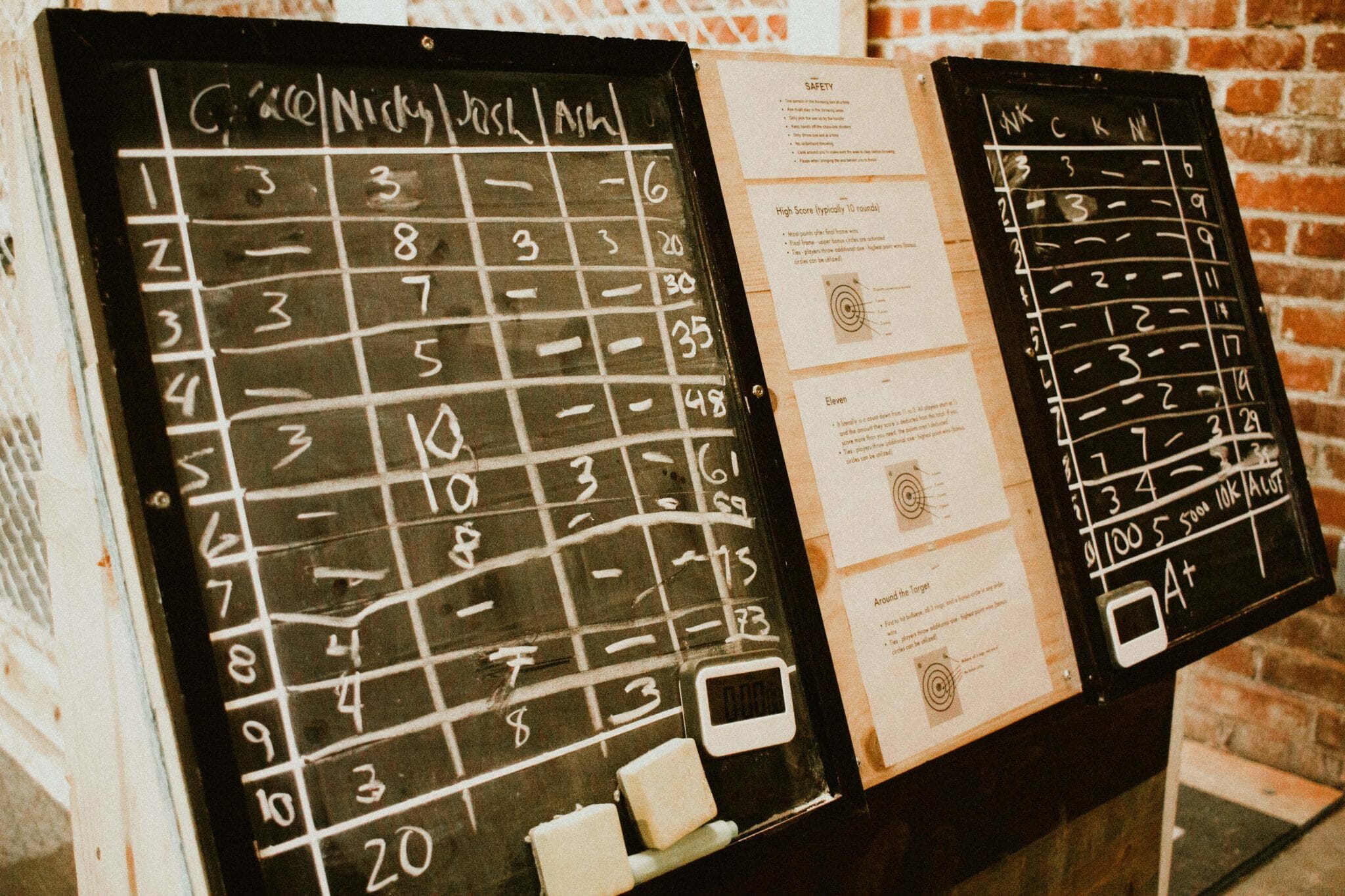
Axe throwing games are alternate ways to score a lane beyond the standard 10-throw match: Around the World, Cornhole, a countdown game we call Eleven, Knockout, Horse, Cricket, Humans vs Zombies, and Landmines. All eight use the same wooden bullseye target and the same overhead throw - only the counting changes - and each fits a 45-minute to 1.5-hour session.
Here are the eight, ranked roughly easiest to hardest, with who each one is for:
| # | Game | Players | Best for | How to win |
|---|---|---|---|---|
| 1 | Around the World | 2–16 | First-timers, dates | Hit every zone in order, low to high and back |
| 2 | Eleven (or 21) | 2–4 | Quick games, kids’ parties | Count down to exactly zero |
| 3 | Cornhole | 2–4 | Head-to-head, couples | First to 21 on the difference of each round |
| 4 | Knockout | Any size | Big groups, fast eliminations | Be the last thrower standing |
| 5 | Horse | 2–4 | Rivalries, trash talk | Don’t spell H-O-R-S-E |
| 6 | Cricket | 2–16 | Regulars, team nights | Close every number three times |
| 7 | Humans vs Zombies | 4–16 | Parties, Halloween | Humans reach +15, zombies reach -15 |
| 8 | Landmines | 8–16 | Corporate groups, big teams | Reach 50 without stepping on a mine |
Player counts come from the World Axe Throwing League’s master list of axe throwing games, the closest thing the sport has to an official games rulebook. Axe throwing is a physical, in-person target sport - real hatchets, wooden targets, enclosed lanes at a venue - and every game below is played from the same throwing line.
What rules do all axe throwing games share?
Two things never change, no matter what you’re playing.
Scoring. Every game counts the zone the blade sticks in. On a standard WATL target the bullseye is 6, the rings count down 5-4-3-2-1 moving outward, and a called killshot is 8. That’s the whole system - our guide to axe throwing rules and scoring covers the 10-throw match, the tie-break, and the WATL-vs-IATF differences, so we won’t repeat them here.
Safety. One thrower in the lane at a time, one axe per throw, and nobody walks up to the target until every axe in the lane has been thrown and the lane is clear. Those are the rules printed on the card at every one of our lanes (pictured above), and the same ones a coach walks your group through before the first throw. We broke the whole system down in is axe throwing safe? - the short version is that games change how you count, never who’s standing at the line.
Want style points instead of scoring variants? That’s a different post: axe throwing trick shots, ranked easiest to hardest.
1. Around the World
The first game most people learn, and the one our coaches reach for with first-timers. Instead of chasing points, you’re chasing zones: each thrower or team has to hit every scoring area in order, low to high and then back down. WATL’s sequence is 1, 2, 3, 4, bullseye, 4, 3, 2, 1, then the killshot to finish; some venues skip the killshot and end on the 1.
Miss your number and nothing happens - you wait for your next turn and keep aiming at the same zone. There’s no bust and no penalty, which is exactly why it works for beginners: a 1-ring is the biggest zone on the board, so everyone gets moving early.
How to win: first thrower (or team) to finish the loop.
Our house version, Around the Target, is printed on the lane card: first to hit the bullseye, all five rings, and a bonus circle in any order wins, and ties go to one extra throw each. The any-order rule makes it faster than the strict WATL sequence, so it fits a 45-minute session with room to spare.
2. Eleven (or 21)
The countdown game. Everyone starts at 11. Each throw’s score is subtracted from your total, and the first thrower to land on exactly zero wins. The catch is the overshoot rule: if you score more than you need, the points aren’t deducted - you stay put and try again next turn. Need 2, stick a 5, and you’re still on 2.
That’s the version on our lane cards, and it’s short enough to run two or three rounds back-to-back. The longer cousin is 21, played by plenty of venues: hit exactly 21 points, and if you go over, you drop back down to 11 (Keene Axe House’s rules page lays it out). Bad Axe Throwing runs the same idea as a “First to X” game with a Busted variant, where the total has to land exactly on the number.
How to win: land on exactly zero (Eleven) or exactly 21 (21). In the endgame, the 1-ring is your friend.
3. Cornhole
Best head-to-head game on the list. Played like the backyard bag game: one thrower from each side throws, the lower score is subtracted from the higher score, and only the difference goes to whoever threw better. A 6 against a 4 is 2 points for the bullseye thrower. A 5 against a 5 is nothing. First to 21 wins, and WATL lists it for two to four players - one-on-one or two-on-two.
Because you only ever gain the margin, a lopsided first throw doesn’t decide the game and a comeback is always on - which is why it’s the game we’d hand a couple. Our guide to whether axe throwing makes a good date has the rest of the logistics.
How to win: first side to 21 on accumulated differences.
4. Knockout
The big-group game that runs itself. Each round every player throws once. Lowest score is out. Keep going until one thrower is left - Keene Axe House calls it Knockout, and you’ll hear it called Last Axe Standing or Last Throw Wins elsewhere. Any number of players works, because the field shrinks every round instead of everyone waiting on a long rotation.
For a crowd, run it across adjacent lanes at once and merge the survivors into a final; ties for lowest throw again, head-to-head. The early rounds go fast because someone always whiffs, so it slots neatly into the last 15 minutes of a session as a finale. Planning a birthday or group outing? Our step-by-step party checklist shows where a bracket like this fits in the timeline.
How to win: be the last thrower who hasn’t been eliminated.
5. Horse
Basketball’s H-O-R-S-E, with axes. Two to four players. Lose a round, take a letter; spell HORSE and you’re out. WATL’s master list gives two ways to play it:
- Closer to Horse - the leader throws and sets a score; you have to match or beat it, or take a letter.
- Closest to Horse - the leader calls a zone (“3-ring, left side”) and hits it; you have to hit the same zone.
Called-shot Horse is the harder version by a mile - play it once your group can hit a ring on purpose instead of by accident. Bad Axe Throwing plays the same game spelling out B-A-D A-X-E, if you want a longer match.
How to win: be the only player left without all five letters.
6. Cricket
The darts game, ported straight over. Pick a set of numbers before you start - the 1 through 5 rings, the bullseye, and the killshot on a full board. Hit a number three times to “close” it. WATL’s version adds difficulty tiers (easy, medium, advanced) that change which numbers are in play and whether closed numbers keep scoring points for you until your opponents close them too.
It’s a long game, which is the point - it rewards consistency over one hot throw. It’s also a good diagnostic: if you can’t close the 3-ring, you’ve found the part of your throw to fix, and our guide to getting better at axe throwing covers the five mistakes that usually explain it.
How to win: close every number first (and, in the scoring variant, with the higher total).
7. Humans vs Zombies
The party game. Split into two teams and keep one shared score that starts at zero. Each round a human and a zombie throw; the difference between their throws moves the tally toward the winner’s side. Humans are trying to push it to +15, zombies are trying to drag it to -15. WATL lists it for 4 to 16 players, and it’s the best-balanced team game for mixed-skill groups because one great throw only moves the needle by a few points.
The version Bad Axe Throwing documents starts with a single zombie, Patient Zero, and converts any human who loses a round into a zombie - so the zombie team grows as the game goes on and the humans have to win outright before they’re all turned. It’s an obvious fit for an October outing; we put it at the center of our Halloween axe throwing ideas.
How to win: humans reach +15 (or survive), zombies reach -15 (or turn every human).
8. Landmines
The team game for big numbers. Built for 8 to 16 players on WATL’s list, Landmines is a race from 0 to 50 in which the numbers 10, 20, 30, and 40 are mines. Teams add up each throw as they go; land your team’s running total exactly on a mine and you’re sent back 10 points from the number you started the turn on. Once a mine has been hit it’s defused for the rest of the game - like a real landmine, it only goes off once. Some venues run it from 50 to 100 instead, with the same spacing.
The fun is in the math: a team sitting on 18 has to decide whether to aim big and jump past 20 or creep up to 19 and hope. Run it across two lanes with a team on each and a coach keeping both totals on the board.
How to win: first team to reach 50 (or 100).
Which axe throwing games work for big groups?
For eight or more people, the winning formats are the ones that keep everyone in the rotation instead of waiting on a single lane: Landmines, Humans vs Zombies, team Cricket, and a multi-lane Knockout as a finale. The numbers behind that: up to four throwers share one lane and take turns, and one lane comfortably handles about five throwers over 1.5 hours - so a 20-person group is four lanes, and the games above are designed to run as two or more teams across those lanes at once.

Our bigger venues are built for exactly this. Our Chattanooga venue in East Ridge has 10 lanes, and our Omaha venue has 15, so a full Landmines or Humans vs Zombies bracket can run without any team sitting out. The parties and events team sets up the lanes, assigns coaches, and runs the scoreboard - you just pick the game.
Which axe throwing games are best for a date?
Head-to-head games that stay close: Cornhole (you only ever gain the margin, so a bad start isn’t fatal), Around the World (no penalties, everyone progresses), and Horse if you’re both competitive enough to enjoy the trash talk. Skip Landmines and Cricket on a date - they’re team games and they run long. A one-hour session covers a game or two plus plenty of practice, which is the length most couples book.
Which games do axe throwing leagues play?
Sanctioned league nights don’t use any of the games above - they play the standard WATL match: 10 throws, highest total wins, killshot sudden death on a tie, four matches a night across an eight-week season. WATL also sanctions Duals, a two-person team format where both partners throw at the same target and both must release before the first axe lands. Our full breakdown of how axe throwing leagues work covers the season structure, and our leagues page lists what each venue runs. The games in this post are what league throwers play on the other nights - Cricket and called-shot Horse in particular.
How long does an axe throwing game take?
Long enough to matter when you book. The rough guide from our session-length breakdown:
- 45 minutes - the coach’s intro, practice throws, and one short game. Around the Target or a round of Eleven fits; Cricket doesn’t.
- 1 hour - a game or two. Cornhole, Around the World, or Horse for a pair or a foursome.
- 1.5 hours - a full rotation: practice, a team game, and a Knockout finale. This is the length for groups of five or more, and the tier that adds ninja stars and premium axes at our venues.
- 2–3 hours - party length. Landmines, Humans vs Zombies, and a bracket, with time to eat between rounds.
Most of these games mean more throws per person than a standard match, not fewer - if you’re wondering whether that adds up, see whether axe throwing is physically demanding.
How do the games work at Craft Axe Throwing?
You don’t need to memorize any of this. Every session starts with a coach who teaches grip, stance, and release, then sets up whatever fits your group - Around the Target for first-timers, a full Humans vs Zombies bracket for a party - and keeps score on the chalkboard at your lane. The house games are printed on the lane card, so the rules are always an arm’s length away.
Some venues add their own. Our Chattanooga location runs free trivia every Thursday with a halftime axe-throw challenge - each player throws one axe and the team’s average score is added to the trivia total - and Wednesday there is league night.
Ready to play? Book a lane in Chattanooga, find your nearest Craft Axe Throwing venue, or send the crew’s headcount to parties and events and we’ll set the board for Landmines.