
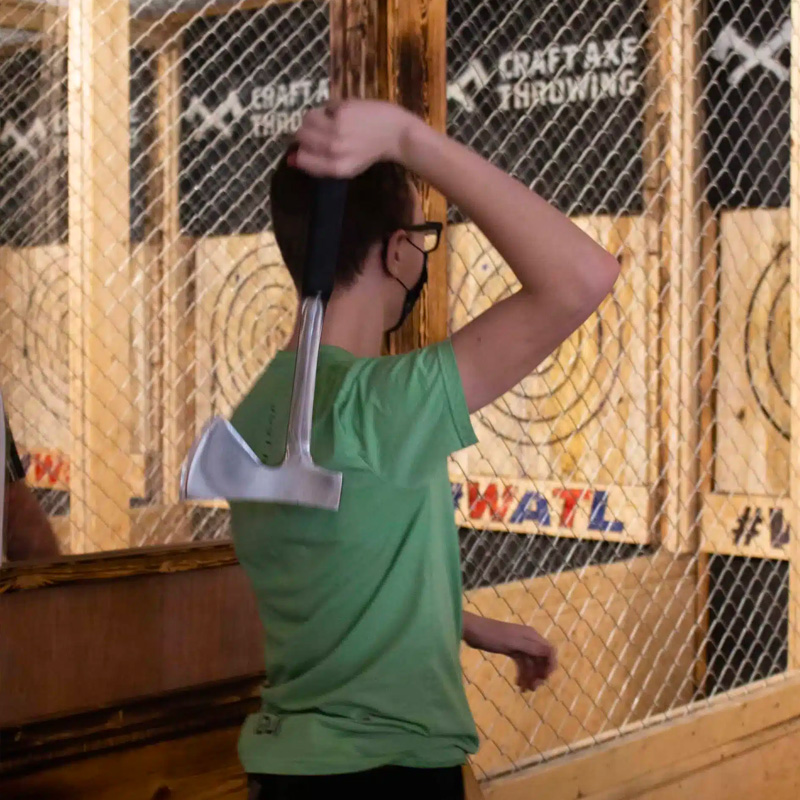
Axe throwing is moderately physical, not strenuous. Anyone who can lift a one-to-two-pound hatchet overhead with both hands can do it, and most beginners stick an axe within 15 minutes. What tires people out is repetition - dozens of throws across a 60-to-90-minute session - not the effort of any single throw.
Key facts:
- Axe weight: one to two pounds for the hatchets our venues hand you; competition rules cap axes at 3 lb with a 19-inch handle.
- Throwing distance: 12 to 15 feet from the target - one full rotation.
- Effort per throw: low. The motion is a two-handed overhead throw, closer to a soccer throw-in than a swing.
- What makes you tired: volume. Dozens of throws plus walking to retrieve the axe every turn, over 45 minutes to 1.5 hours.
- Muscles involved: shoulders, upper back, core, and legs - light load, many repetitions.
- Calorie burn: unmeasured for axe throwing; comparable listed activities (darts, horseshoes, bowling) rate as light activity, about 2.5–3 METs.
- Who can do it: ages 13+ with an adult at most venues, any fitness level, and seated throwers with advance notice.
Is axe throwing physically demanding?
No - it is physical, but not demanding. Axe throwing is a target sport where you throw a small axe at a wooden bullseye down an enclosed lane, and the whole thing is built around control rather than power. The hatchets our coaches hand first-timers weigh one to two pounds. For comparison, the World Axe Throwing League caps competition axes at 3 lb (1.36 kg) and a 19-inch handle, with hatchet throwers standing at a 12-foot fault line and “big axe” throwers at 15 feet. That is a small, controllable tool, not a felling axe.
The throw itself is a smooth two-handed overhead motion. Our step-by-step guide to throwing an axe compares it to a soccer throw-in: grip like a golf club, step forward, bring the axe over your head, and release when the handle is vertical. Power comes from the step and the follow-through, not from the arms. Coaches spend more time getting people to throw softer than harder - an over-muscled throw spins too fast and bounces off the board.
So the honest answer to “is axe throwing physically demanding” is: a single throw asks almost nothing of you. A full session asks a little more, because you repeat that throw dozens of times and walk 12 to 15 feet to pull the axe out of the board after every one. If you have ever played an hour of darts, cornhole, or bowling, you already know roughly how axe throwing feels on the body. Our first-timer guide covers everything else about the first visit.
What muscles does axe throwing work?
Axe throwing works the shoulders and upper back most noticeably, with the core, legs, and grip contributing underneath. It is a whole-body movement performed at a low load.
That is not marketing language - it is how sports medicine describes throwing in general. A review in the Orthopaedic Journal of Sports Medicine on throwing biomechanics calls throwing “a complex skill that requires the coordination of several body segments to generate and transfer forces efficiently,” with pelvic rotation, glute and core activation driving momentum and the deltoid and rotator cuff muscles doing the work at the shoulder, plus the latissimus dorsi in the back. That review is about baseball and football athletes throwing at maximum effort; an axe throw uses the same chain at a fraction of the intensity.
Mapped onto the two-handed axe throw our coaches teach:
| Body region | What it does in the throw |
|---|---|
| Legs and hips | The step toward the line starts the momentum; your weight shifts forward |
| Core (abs, obliques) | Carries that momentum through the forward fold as the axe comes over your head |
| Shoulders (deltoids) and upper back (lats) | Swing the axe from behind your head to the release point and control the follow-through |
| Triceps | Extend the arms toward the target at release |
| Forearms and grip | Hold the handle loosely, then let go cleanly - a light grip, not a clench |
Two things worth knowing. First, because the throw is two-handed and symmetrical, it does not favor one side the way a baseball pitch does. Second, the retrieval matters more than people expect: walking to the target and pulling a stuck axe out of the wooden target is a small pull every turn. Across a session that adds up to an hour of standing, walking, and light lifting - which is also why closed-toe shoes are required.
Is axe throwing a good workout? How many calories does it burn?
Axe throwing is light physical activity, not a workout, and nobody has published a measured calorie figure for it. Any specific number you see online is a guess.
The standard reference for this question is the Compendium of Physical Activities, which assigns every measured activity a MET value (one MET is defined as 1 kcal per kilogram of body weight per hour - roughly the energy cost of sitting quietly). The 2024 adult Compendium has no entry for axe throwing. The closest activities it does list:
| Activity (2024 Compendium) | METs |
|---|---|
| Darts, wall or lawn | 2.5 |
| Football or baseball, playing catch | 2.5 |
| Horseshoe pitching, quoits | 3.0 |
| Bowling | 3.0 (3.8 at an indoor alley) |
| Archery, non-hunting | 4.3 |
Using that range as an analogy - and it is only an analogy - a 155-pound (70 kg) adult at 2.5 to 3.0 METs burns roughly 175 to 210 calories per hour of continuous activity. A lane session is not continuous: up to four throwers share a lane and take turns, so a good share of the hour is spent watching and talking. The realistic figure is lower than that, and it is not a number we can measure for you.
What axe throwing is good for, physically, is getting people who would never book a gym class to spend an hour on their feet doing a skill-based, coordination-heavy movement - and to come back weekly if they join a league. The World Health Organization puts it plainly: “any amount of physical activity is better than none; all physical activity counts.” If you want a workout, go to the gym and then come throw. If you want an active night out that is not a workout, this is it.
Is axe throwing good for you? The stress-relief question
People ask whether axe throwing is therapeutic, and the fair answer is: it is not therapy, but it has the ingredients that research says make physical activity feel good. The WHO fact sheet above lists reduced “symptoms of depression and anxiety” among the benefits of being physically active, and a widely cited review in Primary Care Companion to the Journal of Clinical Psychiatry, “Exercise for Mental Health”, names the mechanisms beyond the physiology: “distraction, self-efficacy, and social interaction.”
An hour on a lane happens to deliver all three:
- Distraction. You cannot think about your inbox while lining up a throw. The task is narrow - distance, grip, release - and it takes your full attention for the two seconds that matter.
- Self-efficacy. Progress is visible and fast. Most beginners go from bouncing axes to a stuck blade inside 15 minutes, and getting better from there is a matter of changing one thing at a time.
- Social interaction. You throw in a group, one at a time, with everyone watching. That is a built-in audience for every bullseye and a built-in laugh for every bounce.
The same review notes that the activity does not need to be heroic: thirty minutes of moderate activity three days a week is its benchmark, and “these 30 minutes need not to be continuous.” Axe throwing is lighter than that benchmark, so treat it as a good hour rather than a health plan. If stress is the reason you are looking, the date-night and group formats work well for exactly this - see why axe throwing makes a good date.
Can you go axe throwing if you’re out of shape, injured, pregnant, or have a shoulder issue?
Out of shape: yes. This is one of the most forgiving activities to show up to untrained. You throw once every minute or two when a lane is shared, the axe weighs one to two pounds, and there is lane-side seating to use between turns. Coaches adjust distance and technique to the thrower, not the other way round.
Shoulder, elbow, or back issues: ask your doctor before you book. The throw is an overhead motion with a forward fold at release, and that is the honest thing to tell a physician. If you get the go-ahead, tell your coach about the injury - they can keep you on a two-handed throw (it spreads the load across both arms), keep you on the standard one-to-two-pound hatchet, and never rush your turn.
Wheelchair users and seated throwers: every Craft Axe Throwing venue is wheelchair accessible, and we can adapt the throwing setup for seated throwers. Let the venue know in advance so the lane is ready when you arrive. See our brand FAQ for the short version of that policy.
Pregnant: this is a question for your doctor, not for a blog post. Axe throwing is an overhead throw with occasional bending to pick up a dropped axe; whether that is right for you and when is a medical call. If you come, tell your coach so they can keep your lane relaxed.
Age and kids: strength is not the limiting factor - coordination and attention are. Most of our venues welcome throwers from 13 with a parent or guardian and 18 on their own; some run kids’ specials from age 10. The full rules are in how old you have to be to go axe throwing.
Whatever your situation, the venue is the safety system - enclosed lanes, a coach on every lane, one thrower at the line at a time. Our guide to whether axe throwing is safe explains how that works.
How tired will I be after a session?
Mildly, at most - and it depends almost entirely on how long you book and how many people share your lane.
Standard sessions run 45 minutes to 1.5 hours; private parties and corporate groups book 2 to 3 hours. Up to four throwers share a lane and rotate one throw at a time, so two people on a lane for an hour each throw dozens of times, while four people on the same lane throw roughly half as often. Our guide to how long axe throwing takes breaks the session menu down. For scale, a sanctioned WATL hatchet match is 10 throws per game.

What to expect, by session length:
- 45 minutes to 1 hour, two to four people: you will feel like you did something - warm shoulders, maybe a little forearm fatigue from gripping - and nothing more. Most couples walk out and go get dinner.
- 1.5 hours, a full lane or a birthday group: more total throws, plus games and a bracket, and the 1.5-hour tier at our venues adds ninja stars and premium axes to the rotation. This is where the throwing arm starts to feel used. Pacing yourself between turns is normal, and the tournament format gives you rests anyway.
- 2 to 3 hours, parties and corporate events: these are built with food and drink breaks in the schedule, so the throwing comes in waves. Nobody throws continuously for three hours.
Venues are indoor and climate-controlled year round, so heat is not a factor. Drink water, and if you are booking a long session for a large group, spread people across more lanes rather than stacking one - it is more throws per person and less waiting. Our axe throwing games guide has formats that keep a big group rotating.
The day after, some first-timers notice their shoulders and upper back, especially if they threw a lot or threw hard. That is the ordinary soreness of repeating an unfamiliar movement, and the next section is how to avoid it.
How do you throw without hurting your arm?
Throw smoothly, not hard. Almost every sore arm we see comes from someone trying to muscle the axe into the board, and almost every fix is the same one that makes the axe stick more often. Our coaches teach these on the lane, and the step-by-step throwing guide and the five mistakes that keep axes from sticking cover them in detail.
- Loosen your grip. A “death grip” on the handle tenses the whole arm and twists the axe head at release. Hold it like a golf club, firm enough not to slip, and let go cleanly.
- Stop over-throwing. The axe rotates on its own; that is what the 12-to- 15-foot distance is for. Extra force just speeds the rotation and bounces the axe off the board. A relaxed, medium-speed throw sticks better and costs your shoulder less.
- Keep your wrists quiet. A wrist flick adds rotation and strain without adding accuracy. Release when the handle is vertical and let the arms follow through straight at the target.
- Start two-handed. The two-handed overhead throw spreads the load across both shoulders and is easier to control. Move to one-handed throws once the rotation is dialed in, not before.
- Fix distance before you fix anything else. If the axe keeps hitting handle-first, step back a few inches; if it over-rotates, step forward. Most “I’m throwing wrong” frustration - and the extra-hard throws that follow - is a distance problem.
- Warm up with a few easy throws, and stop if anything hurts sharply. Normal fatigue is a warm, tired feeling; pain is not, and a coach would rather you sit a turn than push through it.
Follow those and axe throwing stays what it is for almost everyone: an active, absorbing hour that you feel a little the next morning and want to repeat the next week.
Ready to find out how demanding it is for you? Check out axe throwing in Columbia, SC - two floors and 17 lanes on Gervais St in downtown Columbia - or axe throwing in Memphis, TN, then book a lane and wear closed-toe shoes.