
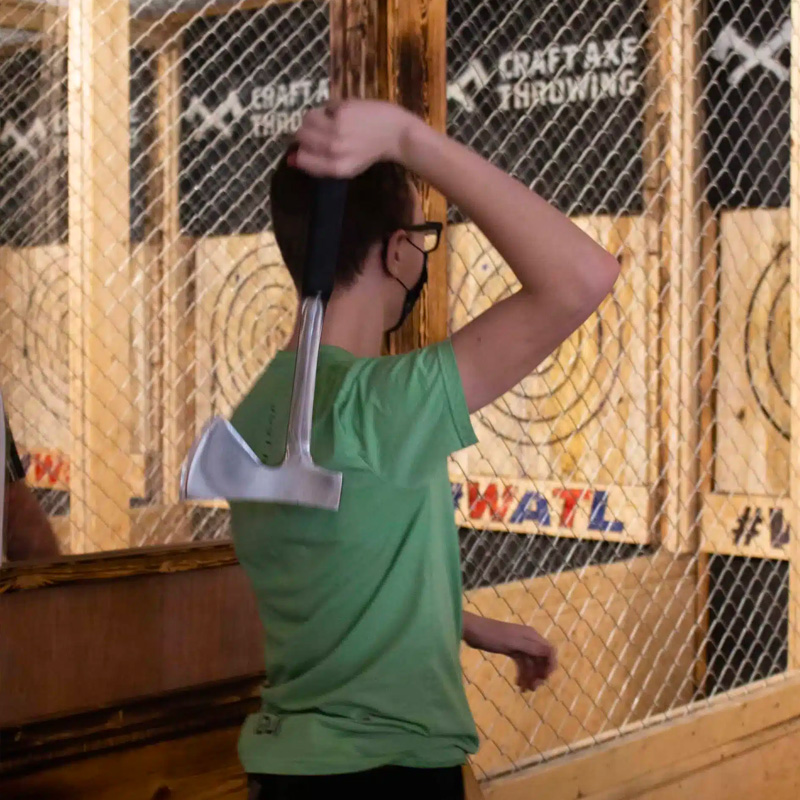
The fastest way to get better at axe throwing is to stop changing everything at once. Nearly every stuck beginner is making one of five fixable mistakes - gripping too hard, throwing too hard, flicking the wrists, standing at the wrong distance, or adjusting three things after every miss. Fix them one at a time and your throws go from random to grouped around the bullseye in a single session.
Our coaches watch thousands of throws a week across ten venues, and the same five problems account for almost every “why am I so bad at this?” conversation on the lanes:
- The death grip - squeezing the handle twists the axe on release.
- Muscling the throw - power ruins rotation; smooth beats hard.
- Wrist flick - adds spin the axe doesn’t need.
- Wrong distance - almost every rotation problem is a distance problem.
- Changing everything after every miss - you can’t diagnose three variables at once.
If you haven’t nailed the basic throw yet, start with our step-by-step guide to throwing an axe, then come back here to tune it.
Mistake 1: You’re gripping the axe too hard
A white-knuckle grip is the most common flaw coaches correct in the first ten minutes. Squeezing twists the axe head a few degrees at release, and a few degrees at the line becomes several inches at the board - that’s your mystery left-right scatter. Hold the end of the handle like a golf club: firm enough that it won’t slip, relaxed enough that your forearms aren’t flexed. The blade should face the target dead-on, not tilted.
Mistake 2: You’re throwing too hard
Beginners try to bury the axe; good throwers let it fall into the board. A harder throw flattens the arc, speeds the rotation, and tenses every muscle that needed to stay loose - it’s also why people who muscle every throw are the ones with sore arms the next day, even though axe throwing isn’t physically demanding when the form is smooth. The axe only weighs one to two pounds - it needs a smooth, two-handed overhead motion, like a soccer throw-in, with an easy follow-through. If your axes are bouncing off the board hard, you’re almost certainly over-throwing; take twenty percent off and watch them start sticking.
Mistake 3: You’re flicking your wrists
The axe rotates on its own - that’s what the 12-to-15-foot distance is for. Any wrist snap at release adds extra spin on top, and extra spin is the most common reason throws go wild. Lock your wrists as if the axe handle were a splint, release when the handle is vertical at about eye level, and let your arms continue down and forward. Rotation comes from physics, not from you.
Mistake 4: You’re standing at the wrong distance
Distance controls rotation, and rotation decides whether the blade or the handle reaches the board first. The reads are simple:
| What you see | What it means | The fix |
|---|---|---|
| Handle hits first | Under-rotated | Take a half step back |
| Top of the axe head hits first | Over-rotated | Take a half step forward |
| Axe hits flat and drops | Rotation is right | Same spot, slightly more speed |
Find the spot where your natural throw completes exactly one rotation, then mark it and stop moving. Your distance is personal - taller throwers and longer arms shift it a few inches - which is why copying your friend’s line position rarely works.
Mistake 5: You change everything after every miss
This is the improvement killer. Miss once, and most beginners adjust their grip, their stance, and their power on the very next throw - which means they learn nothing from either attempt. Coaches use a one-variable rule: keep everything identical and change exactly one thing per throw. Same foot position, same grip, same wind-up, one adjustment. It feels slow for five minutes and then suddenly you’re grouping throws - consistency is the entire skill.
Why won’t my axe stick?
The most-asked question on our lanes, and it’s almost always one of four causes - in this order:
- Distance. A non-sticking axe is usually an axe arriving mid-rotation. Read the board like the table above: handle-first means step back, head-first means step forward.
- Rotation you added. Wrist flick or a hard, tense throw spins the axe past its natural single rotation. Quiet hands, smooth release.
- Grip pressure. A twisted release lands the blade at an angle, so it glances off instead of biting. Relax the grip and keep the blade vertical.
- Over-throwing. Speed flattens your arc and slams the axe flat against the board. If it’s hitting hard and dropping, throw softer - the satisfying thunk comes from accuracy, not violence.
Our coaches see beginners stick their first axe within about 15 minutes precisely because they work this checklist instead of guessing - and any coach at a Craft Axe Throwing venue will happily diagnose your throw mid-session. It’s included, not an upsell.
How do you practice getting better?
Once you’re sticking axes, structure beats volume:
- Build a pre-throw routine. Same starting spot, same breath, same wind-up every time. Boring is the goal.
- Keep score. Playing to WATL-style points forces you to aim at rings instead of “the board” - our rules and scoring guide has the full target breakdown.
- Play games with pressure. Elimination brackets and team matches teach you to repeat your throw when it counts.
- Aim small. Pick a specific nail hole or knot, not the bullseye zone. Your misses shrink with your target.
- Graduate on purpose. One-handed throws, ninja stars, and trick shots come after your standard throw is automatic - they’re rewards, not shortcuts.
How long does it take to get good at axe throwing?
First stick: usually within 15 minutes. Grouping throws near the bullseye: one or two sessions. Genuinely good - killshots on call, consistent 40-plus games - takes weekly reps, which is exactly what an 8-week league season is for: one competition night a week, all skill levels, at a cost that works out to roughly $21 a week. League night is where almost every great thrower we know actually got great — here’s how a league season works if you’re curious what you’d be signing up for.
Ready to put the checklist to work? Grab a lane at your nearest Craft Axe Throwing venue - bring two or three friends and the per-thrower rate drops, or make it a full party or team event and let a coach run the competition for you.