
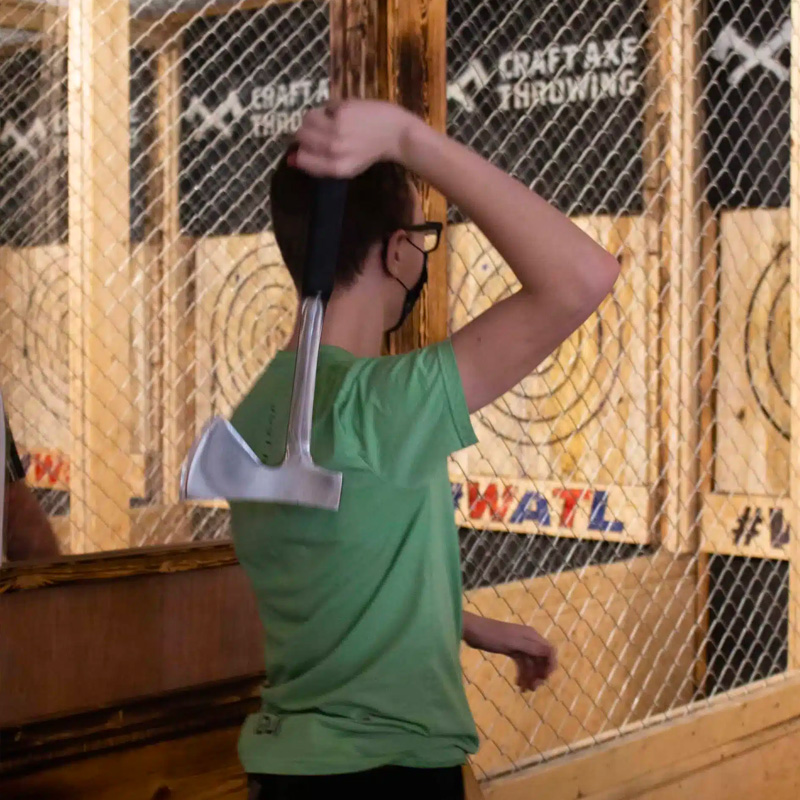
So you’ve stuck the bullseye. Maybe twice in a row. Maybe you called a killshot, hit it, and your group chat still hasn’t recovered. Time to get weird with it. Axe throwing trick shots are alternate throws - underhand, off-hand, no-look, extra distance, no-spin, and behind-the-back - that trade the standard overhead mechanics for style points. Here are the six our coaches get asked about most, ranked easiest to hardest, with the exact steps to land each one on your next visit.
The lineup, in order:
- The Underhand Lob - a slow, granny-style arc from the hip
- The Southpaw - your standard throw, wrong hand
- The No-Look - set your stance, turn your head, let it fly
- The Long Bomb - step back and add a full rotation
- The No-Spin - blade-forward push, zero added rotation
- The Behind-the-Back - the crown jewel
Before you try any of these
Trick shots are welcome whenever a coach clears the lane - so ask your axepert first. They’ll tell you what’s allowed, and most will happily demo the shot instead of just describing it. The standard rules still run the show: one thrower on the lane at a time, everyone else behind the line, and house rules always apply - your coach has the final call. These shots are for supervised venue lanes, not your backyard. If you’re still new to all this, start with what to expect on your first visit and come back once the bullseye stops feeling lucky.
1. The Underhand Lob
Difficulty: 2 out of 5 axes. The granny shot. You swing the axe in a slow pendulum arc from beside your leg instead of over your head - it looks ridiculous right up until it sticks, which is most of the appeal.
How to land it:
- Grip the very end of the handle with the axe hanging at your side, blade facing the target.
- Lock your wrist and elbow so the handle works like an extension of your arm.
- Step into the throw and swing one smooth pendulum arc - no muscle, just momentum.
- Release at belt-buckle height with your arm straight. Open your hand and let go clean.
Aiming feels strange at first because you’re releasing from your waist, nowhere near your eyes. That’s normal - finding the release point is the whole trick. Most common mistake: flicking the wrist at release. The lob lives on a slow, lazy arc; a wrist snap adds spin and slaps the handle into the board.
2. The Southpaw
Difficulty: 2 out of 5 axes. Our coaches’ name for the off-hand throw: identical mechanics, humbling results. Nothing about the throw changes - only your brain’s ability to execute it.
How to land it:
- Mirror your normal setup exactly - feet square, shoulders square, same grip at the end of the handle.
- Cut your power in half. Rotation comes from distance, not muscle, and your off arm doesn’t know its own strength yet.
- Release at the same point as your standard throw - handle vertical, arms pointing at the bullseye.
- Read your misses like a first-timer again and adjust one thing at a time.
If your fundamentals are shaky on your strong side, brush up on basic throwing mechanics first - the Southpaw copies whatever habits you feed it. Most common mistake: throwing harder to compensate. Extra muscle on your weak side sends the axe sideways, not deeper.
3. The No-Look
Difficulty: 3 out of 5 axes. Another house name from our coaches: set your stance, lock your sightline, turn your head, and throw anyway. When it sticks, act like you knew it would.
How to land it:
- Warm up with two or three normal throws so your distance and release are dialed.
- Set your feet and shoulders, then stare down the bullseye to burn in the sightline.
- Turn your head - and only your head. Shoulders stay frozen on target.
- Commit to your exact standard release. Your body remembers where the board is; trust it.
Most common mistake: peeking. Sneaking a mid-throw glance pulls a shoulder open and drags the axe sideways. Half a no-look scores like a full miss, so pick one and commit.
4. The Long Bomb
Difficulty: 4 out of 5 axes. A standard throw is one full rotation from roughly 12 feet - that’s where the WATL throwing line sits. The Long Bomb backs way off that mark and gives the axe room for an extra rotation on the way in.
How to land it:
- Start at your normal mark, then step back several feet.
- Use the rough rule of thumb: adding about half your standard distance buys one more rotation. It’s a starting point, not a law - every axe and every arm is different.
- Throw the same smooth overhead throw with a touch more speed. More speed, not more spin.
- Adjust with your feet: handle hits first, step back; blade over-rotates, step forward.
Most common mistake: muscling it. Distance tempts you to heave, and a heave breaks the clean release that got you here in the first place.
5. The No-Spin
Difficulty: 4 out of 5 axes. The no spin axe throw keeps the blade facing the target for the entire flight - no added rotation, just a straight, knife-style push release. Our own crew still argues about whether it’s a trick shot or just elite technique. Both sides are right.
How to land it:
- Move in closer than your normal mark - the no-spin is a short-range throw.
- Set up with the blade aimed at the target from the start; it leads the whole way.
- Push the axe in a straight line, like you’re shoving it down a rail, with a stiff wrist.
- Release without any snap. Your hand opens; nothing else moves.
Fair warning: this one is harder than a normal throw, not easier. Rotation is what stabilizes an axe in flight, so taking it away means tiny errors show up fast - and a little drift on the way in is normal. Most common mistake: letting the wrist snap at release, which adds back the exact rotation you’re trying to remove.
6. The Behind-the-Back
Difficulty: 5 out of 5 axes. The crown jewel. The behind the back axe throw is the shot everyone films and almost nobody sticks on the first night - expect to miss a lot before it drops, and enjoy every second of the process.
How to land it:
- Get a coach demo first. Non-negotiable - watch it thrown before you try it.
- Stand with your back to the target, axe in your dominant hand, lane completely clear.
- Swing smooth and slow over your shoulder, letting the axe travel its full arc.
- Commit to one release point and let it fly - no steering, no second-guessing mid-swing.
Most common mistake: rushing it. A fast, tense swing scatters axes everywhere but the board. Slow, smooth, and repeatable beats hard and hopeful - film it anyway, because the miss reel is half the fun.
Which trick shot should you learn first?
Start with the Underhand Lob. It has one variable to solve - the release point - and it teaches you to feel exactly when the axe leaves your hand, which quietly improves every other throw on this list. Master the lob and the No-Look gets easier, the Long Bomb gets readable, and the Behind-the-Back stops being pure chaos.
Better yet, don’t learn any of them from a blog post alone. Ask your coach to demo whichever shot you want to steal - showing off is a core part of the job description. Then book a lane at your nearest Craft Axe Throwing location, bring a crew worth impressing - parties and events welcome - and get weird with it. If the crew wants a real competition to go with the highlight reel, our axe throwing games guide has eight formats to run on the lane.